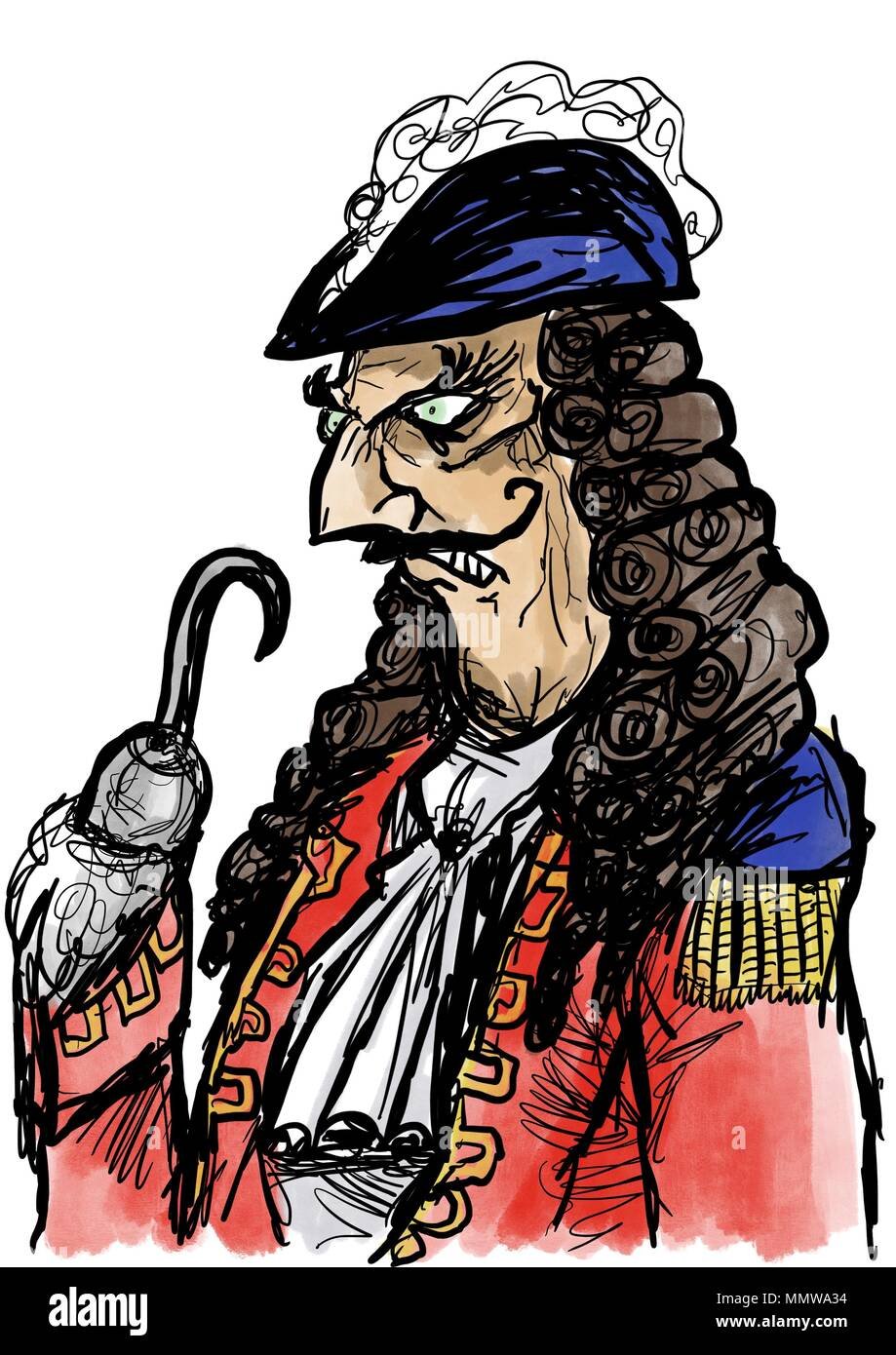
The world of Neverland is a tapestry woven with magic, mischief, and a perpetually youthful boy who refuses to grow up. But what would this fantastical realm be without its darkly charismatic foil? We're talking, of course, about The Original Captain Hook: Barrie's Literary Creation, a villain so enduringly popular that his shadow stretches across more than a century of storytelling. Yet, many of us, shaped by screen adaptations, know only a caricature of the complex, formidable figure J.M. Barrie first conjured. Barrie’s Hook was far more than a bumbling pirate; he was a gentleman buccaneer steeped in mystery, defined by his fears, and possessing a chilling elegance.
At a glance: Barrie's Original Captain Hook
- Late Bloomer: Captain Hook wasn't in early drafts of Peter Pan; he was introduced later and expanded due to audience fascination with pirates.
- A Man of Mystery: Barrie deliberately shrouded Hook's past, hinting at elite education (Eton, Oxford) and a powerful pirate lineage.
- Elegant & Deadly: Described as a skilled swordsman with a "handsome countenance" and refined speech, despite his bloodthirsty nature.
- Primal Fears: Terrified of the crocodile that swallowed his hand (and an alarm clock), and the sight of his own blood.
- Dual Role Tradition: The iconic stage tradition of one actor playing both Captain Hook and George Darling began accidentally.
- Darker Roots: Barrie's original portrayal was a more serious, cunning, and less comical villain than many later adaptations suggest.
Barrie's Masterstroke: Crafting the Arch-Nemesis
When J.M. Barrie first conceived Peter Pan; or, The Boy Who Wouldn't Grow Up in 1904, his initial drafts presented a rather different landscape. Peter Pan himself edged closer to an amoral, even villainous character, far from the unequivocal hero we often imagine. Intriguingly, Captain James Hook, the very embodiment of Neverland’s menace, was conspicuously absent from these early iterations.
Hook’s genesis was almost an organic one, evolving out of necessity and audience fascination. He was initially introduced as a "front of cloth" character, a theatrical device meant to entertain the audience during scene changes. But something clicked. Children, perhaps more than anyone, were captivated by the allure of pirates—the swashbuckling adventure, the forbidden freedom, the clear lines between good and evil (or so it seemed). Barrie, ever the astute observer of human (and childlike) psychology, recognized this magnetic pull. He began to expand Hook's role, transforming him from a mere interlude figure into the formidable, unforgettable antagonist we know today. This organic development speaks volumes about Hook's inherent theatricality and his instant resonance with audiences.
The Enigmatic Pirate: Name, Lineage, and Lore
One of the most captivating aspects of Barrie's original creation is the shroud of mystery he deliberately cast over Captain Hook's true identity. Barrie himself asserted that "Hook was not his true name," an intriguing declaration that immediately elevates the character beyond a simple villain. It suggests a past, a hidden life, perhaps even a nobility that he abandoned or was forced to leave behind.
Barrie sprinkled tantalizing clues about Hook's forgotten pedigree. He’s hinted to have attended the prestigious Eton College, a boarding school synonymous with British aristocracy and power, and subsequently Balliol College, Oxford, one of the world's most ancient and renowned universities. His final, poignant words in the play, "Floreat Etona," which means "May Eton Flourish," serve as a chilling testament to this rumored past, a last gasp of a life left far behind. This sophisticated background starkly contrasts with the brutish image typically associated with pirates, making Hook a far more complex and psychologically rich character.
Beyond academia, Barrie wove Hook into the very fabric of pirate legend. He suggested that Hook had once served as Blackbeard's boatswain, a chief petty officer on a pirate ship, implying a deep, dark history within the most infamous pirate crews. More strikingly, Barrie claimed that Hook was the only man Long John Silver, the legendary pirate from Robert Louis Stevenson's Treasure Island (whom Barrie referred to as Barbecue), ever feared. These literary allusions are not mere trivia; they firmly place Hook within a pantheon of iconic antagonists, giving him a gravitas and a sense of history that few other fictional villains possess. Some literary critics even draw compelling parallels between Hook's relentless, almost obsessive pursuit of Peter Pan and Captain Ahab's monomaniacal quest for Moby Dick in Herman Melville's masterpiece, further cementing Hook's place in the literary consciousness.
A Gentleman of Villainy: Hook's Striking Portrayal
Barrie's original depiction of Captain Hook stands in stark contrast to many of the more comical or overtly villainous portrayals we've come to expect. This wasn't just any pirate; this was a gentleman gone rogue, a figure of dark elegance and unexpected contradictions.
Physically, Hook was described with meticulous detail. He was "cadaverous" and "blackavised"—terms that conjure an image of a gaunt, dark-complexioned man, perhaps a shadow of his former self. Yet, he also possessed a "handsome countenance" and piercing blue eyes, framed by long, dark curls. His attire was equally striking, resembling that of Charles II, the flamboyant Restoration king, hinting at a decadent, almost theatrical flair. This aesthetic carefulness suggests a man obsessed with appearances, even as he commanded a ship of ruffians.
More than just looks, Hook was depicted as a very skilled swordsman, a formidable opponent in battle. His elegance wasn't confined to his appearance; it extended to his diction. Even when delivering curses or commands to his crew, his speech was refined, almost poetic. This juxtaposition of sophisticated manners and brutal actions makes him a truly unsettling villain. He could quote classical literature one moment and order a plank walk the next.
Barrie himself described Hook as "not wholly unheroic." This isn't to say he was good, but rather that he possessed a certain grandiosity, a tragic flaw, and a tenacious spirit that, in another context, might be admirable. He was callous and bloodthirsty, yes, but there was a depth to his villainy that transcended simple evil. He embodied a decaying aristocracy, a lost grace, and a desperate pursuit of revenge. This nuanced portrayal is key to understanding the full power of Captain Hook Once Upon a Time and his enduring legacy.
The Unrelenting Tick-Tock: Hook's Primal Fears
For all his outward bravado, sophisticated veneer, and command over a ruthless pirate crew, Captain Hook was fundamentally a creature of profound fear. Barrie masterfully used these vulnerabilities to humanize Hook, making him both pitiable and terrifying. His two principal fears were deeply intertwined with his nemesis, Peter Pan.
The most iconic of Hook's terrors is undoubtedly the crocodile. The story dictates that in a brutal sword fight, Peter Pan severed Hook's hand and, in a moment of juvenile cruelty or perhaps strategic brilliance, fed it to a crocodile. This act cemented Hook’s new name, but it also initiated a relentless, primal chase. The crocodile, having acquired a taste for pirate flesh, became Hook's personal tormentor, pursuing him across Neverland with single-minded determination.
What makes this pursuit even more agonizing for Hook is the crocodile's unexpected snack: an alarm clock. This swallowed timepiece perpetually ticks within the reptile's belly, serving as an audible harbinger of doom. For Hook, that constant "tick-tock" isn't just a sound; it's a chilling countdown, a ceaseless reminder of his vulnerability and the ever-present danger lurking just out of sight. It's a brilliant stroke of psychological torture, an internal clock of dread that follows him everywhere.
Hook's second, perhaps more visceral, fear was the sight of his own blood. This phobia, unusual for a pirate captain, further underscores his complex nature. It suggests a sensitivity, perhaps a lingering connection to his "gentlemanly" past, that even the rigors of piracy couldn't entirely erase. This fear not only makes him recoil from his own injuries but also hints at a deeper existential dread—a fear of mortality, of the finality of physical harm, which is a stark contrast to Peter Pan's seemingly invincible, immortal youth.
Beyond the Stage: The Curious Case of George Darling
One of the most cherished and enduring traditions of Peter Pan stage productions stems from an almost accidental casting decision that profoundly shaped Captain Hook's theatrical identity. The tradition of having the same actor play both the strict, sometimes stuffy patriarch George Darling and the menacing Captain Hook is now a cornerstone of the play's legacy.
This tradition began not as a deliberate artistic choice by Barrie, but through the persuasion of an actor. Gerald du Maurier, a celebrated actor of his time and Barrie's brother-in-law, was cast as George Darling in the original 1904 production. The role of Captain Hook was initially intended for Dorothea Baird (who played Mary Darling), a decision that reflects Barrie’s early fluid ideas about the character. However, du Maurier convinced Barrie to let him take on the pirate captain as well. His success in both roles was immediate and resounding.
This dual casting quickly became an iconic part of the Peter Pan experience, replicated in countless stage and film productions worldwide, from Dustin Hoffman's memorable turn in Hook (1991) to Jason Isaacs' dual portrayal in Peter Pan (2003). The tradition adds a fascinating layer of subtext, subtly linking the stifling authority of the adult world with the exhilarating, yet dangerous, freedom of Neverland. It suggests that the monsters children fear in their imaginations might be projections of the very adults who dictate their waking lives, or perhaps that the mundane anxieties of adulthood are merely different manifestations of the same fears faced in fantastical realms.
The Evolution of a Villain: From Stage to Screen
While Barrie's original literary creation painted a picture of a sophisticated, dark, and complex villain, the journey of Captain Hook from the stage to various screen adaptations has seen him undergo significant transformations. Many popular interpretations, particularly from Disney and various movie versions, have often veered away from Barrie’s nuanced portrayal, opting for a more broadly accessible, often comedic, and sometimes cowardly villain.
- Barrie's Original: The original Hook was a figure of menace and dark elegance. He was cunning, articulate, and genuinely dangerous. His fears were profound, but his ruthlessness was undeniable. Barrie invested him with a tragic sense of a fallen gentleman, his villainy tinged with a peculiar sort of dignity. He was a formidable foe, not one to be easily dismissed.
- Disney's Influence: The 1953 Disney animated classic Peter Pan cemented a largely comical portrayal of Hook for generations. This version, while iconic, often depicted him as a bumbling, easily thwarted pirate, prone to temper tantrums and cowardice, frequently outsmarted by Peter Pan and even his own first mate, Smee. While he still harbored a genuine hatred for Peter, his menace was significantly diluted for a younger audience.
- Live-Action Interpretations: Subsequent live-action films have offered varied takes. Some, like Steven Spielberg's Hook (1991) starring Dustin Hoffman, leaned into the more theatrical and even pathetic aspects of the character, exploring his inner turmoil but retaining a degree of comic villainy. Others, like P.J. Hogan's Peter Pan (2003) with Jason Isaacs, attempted to restore some of Barrie's original menace and psychological depth, portraying Hook as more genuinely frightening and less of a buffoon. Actors like Tim Curry (in Peter Pan and the Pirates), Danny Kaye (in a musical version), Ian McShane (in Pan), and Hans Conried (who famously voiced him for Disney) have all brought their unique flair to the character, showcasing the wide spectrum of interpretations possible.
The shift towards a more comical or cowardly Hook in many adaptations can be attributed to several factors: the desire to make the story less frightening for young audiences, the comedic potential of a perpetually frustrated villain, and the simplification often inherent in adapting complex literary characters for visual media. While these interpretations have their own charm and have introduced Captain Hook to millions, it's crucial to remember that they often represent a departure from the more evil buccaneer—a man "not wholly unheroic" but undeniably dangerous—that J.M. Barrie first envisioned.
The Lingering Shadow: Why Hook Endures
More than a century after his creation, Captain Hook continues to captivate imaginations worldwide. He remains one of literature's most recognizable and enduring villains, a testament to Barrie's genius in crafting a character with such profound psychological depth and theatrical flair. But why does he endure?
His longevity lies in his complexity. Hook isn't a one-dimensional villain; he embodies a rich tapestry of contradictions. He's elegant yet ruthless, educated yet barbaric, commanding yet consumed by primal fears. This multifaceted nature makes him compelling, allowing audiences to find layers beneath the hook and the pirate garb. He serves as the perfect foil to Peter Pan, representing the inexorable march of time, the corrupting influence of adulthood, and the darkness that can lurk within even the most sophisticated facade. Peter is eternal youth; Hook is the tragic inevitability of growing old, bitter, and fearing death.
Furthermore, Hook taps into universal themes: the fear of the unknown, the pursuit of revenge, the struggle against an insurmountable foe (be it a boy or a crocodile). His theatricality, enhanced by the dual role tradition, ensures he remains a dynamic and memorable presence on stage and screen. He's a character who demands attention, whether through his grand pronouncements or his silent, brooding menace. He's not just an antagonist; he's a vital force that shapes Peter Pan's world, making the boy hero's journey all the more exciting and meaningful.
Unmasking Misconceptions: What Barrie Really Intended
Given the sheer volume of adaptations, it's easy to fall prey to common misconceptions about Captain Hook. The most prevalent misunderstanding is that Barrie intended him to be primarily a comedic, bumbling villain. This couldn't be further from the truth.
Barrie's Hook was a serious threat. He was manipulative, intelligent, and capable of genuine cruelty. While he had moments of frustration and even despair, he was never truly a joke. The humor, when present in Barrie's writing, often arose from the dark irony of his situation or the clash between his refined sensibilities and his pirate reality, rather than from his inherent ineptitude. He was a master strategist, commanding fierce loyalty from his crew, and his pursuit of Peter Pan was driven by a deep-seated, almost existential hatred, not just petty annoyance.
Another misconception is that his missing hand is his defining characteristic. While the hook is undeniably iconic, Barrie focused more on the psychological impact of its loss—the fear of the crocodile, the constant reminder of his vulnerability—than on the physical limitation itself. The hook is merely the symbol of his torment, not the sum of his character.
Barrie crafted a villain who was a mirror to Peter's own wildness, a symbol of the darker side of adulthood and the dangers that lurk beyond eternal youth. Understanding Barrie's original intent allows us to appreciate the depth and genius behind a character who continues to haunt and delight us, reminding us that even villains can be profoundly human.
Barrie's Legacy: The Enduring Allure of Neverland's Pirate
J.M. Barrie’s original Captain Hook is a masterclass in character development, a testament to the power of a villain who is both deeply flawed and incredibly compelling. He’s a character who transcends simple good versus evil, offering a nuanced exploration of fear, pride, and the often-tragic consequences of an unfulfilled life. While many subsequent adaptations have taken liberties, shaping Hook to fit different narrative and audience expectations, the essence of Barrie’s creation—the elegant, mysterious, and profoundly fearful gentleman buccaneer—continues to resonate.
To truly appreciate the enduring magic of Neverland, it's worth revisiting Barrie's original play and novel, allowing his literary creation to emerge from the shadow of later interpretations. You'll find a Hook who is less caricature and more complex psychological study, a figure whose dark allure is precisely why he remains Peter Pan’s ultimate, unforgettable nemesis. Dive into Barrie's pages, and you'll discover the chillingly refined pirate whose ticking clock and hidden past make him one of the most fascinating characters ever to sail the literary seas.